The ideal gas law
Connecting pressure, volume, temperature, and the amount of a gas.
The model
Section titled “The model”An ideal gas is a model in which particles have negligible volume and no intermolecular interactions, except during elastic collisions. The equation connects its macroscopic properties.
Here is absolute pressure, is volume, is amount of substance, and is absolute temperature. Use kelvin for temperature and consistent units throughout.
Choosing units
Section titled “Choosing units”In SI units, use in pascals, in cubic metres, and . Since , the units are consistent.
A worked example
Section titled “A worked example”One mole of ideal gas occupies at . Converting the volume to gives:
Reading an isotherm
Section titled “Reading an isotherm”At constant temperature and amount, pressure is inversely proportional to volume. Doubling the volume halves the pressure.
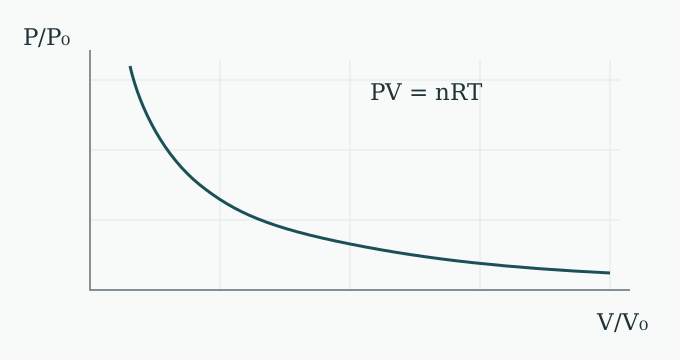
Example diagram — replace with your own figure. Schematic, not to scale.
Limits of the model
Section titled “Limits of the model”Real gases deviate from this model, especially at high pressure or near condensation. An ideal-gas calculation should always begin by checking that the approximation is appropriate.